
SecureMyEmail logoSecureMyEmail

Microsoft 365 security guide

Use separate administrator accounts in Microsoft 365

A practical, step-by-step guide for Australian businesses. Separate everyday accounts from admin work, apply least-privileged roles, and avoid tenant lockout.

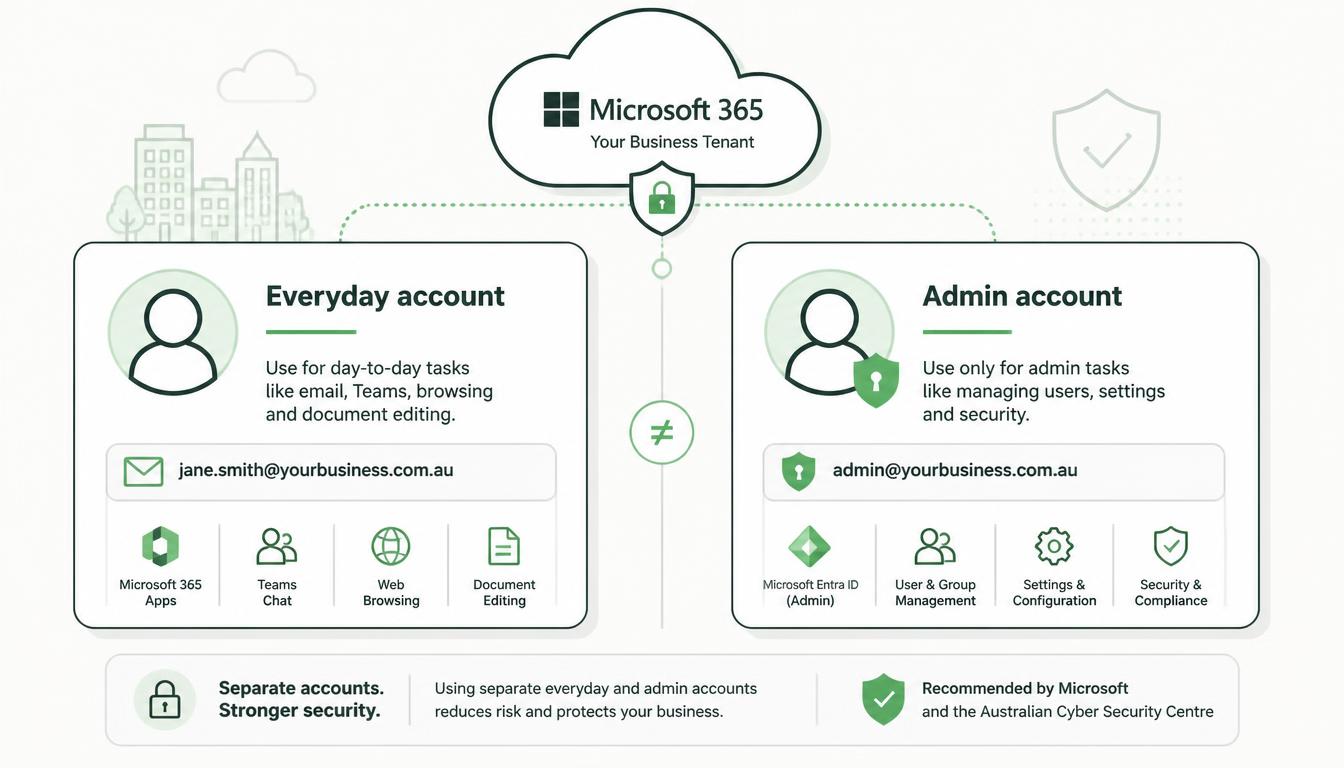
Microsoft 365 separate administrator accounts: everyday user profile separated from privileged admin account with Entra ID and security shield

Recommended practice: separate administrator accounts

Microsoft recommends that administrators use a standard account for everyday activities and a separate, dedicated account for administrative work. This reduces the likelihood that an email, malicious website, stolen browser session or compromised workstation will provide an attacker with administrative access. The admin account generally does not require a Microsoft 365 licence.

Example

Everyday account: neil@business.com.au

Separate administrator account: neil.admin@business.onmicrosoft.com

Before you begin

Make sure:

  • You are signed in with an existing Global Administrator account.
  • You have access to at least two working administrative accounts before removing any existing permissions.
  • Each administrator has a separate, identifiable account. Do not share named administrator accounts.
  • You have documented which administrative roles each person requires.
  • Administrators have registered Microsoft Authenticator, a passkey or a FIDO2 security key.
  • You have created and tested emergency-access accounts before changing Conditional Access policies.

Critical warning: Do not remove administrative permissions from the existing account until the new administrator account has been created, secured and successfully tested. Otherwise, you could lock yourself out of the Microsoft 365 tenant.

1

Create the separate administrator account

Open the Microsoft 365 admin centre and sign in with an existing Global Administrator account.

  • Select Users, then Active users, then Add a user.
  • Enter an identifiable name, such as First name: Neil, Last name: Admin, Username: neil.admin.
  • Preferably use the tenant’s original Microsoft domain: neil.admin@business.onmicrosoft.com.
  • Generate a strong temporary password.
  • Select Require this user to change their password when they first sign in.
  • Do not assign a Microsoft 365 licence unless the account genuinely requires a licensed service.
  • Continue to the role-assignment section.

Using the .onmicrosoft.com domain reduces the admin account’s dependency on the organisation’s public domain and associated DNS configuration.

Do not configure email forwarding or a mailbox for this account. Giving an admin account a mailbox encourages everyday use and exposes it to email-based attacks.

2

Assign the appropriate administrative role

Do not automatically assign Global Administrator. Use the least-privileged role that allows the administrator to complete their work.

  • During account creation, open Roles, select Admin centre access, then select the required role or roles.
  • Alternatively, open the Microsoft Entra admin centre, select Entra ID → Users, open the new administrator account, select Assigned roles, then Add assignments.
  • Choose the required role, select Next, followed by Assign.

If Microsoft Entra ID P2 or Microsoft Entra ID Governance is available, use Privileged Identity Management (PIM) so powerful roles can be activated only when required instead of remaining permanently active.

Global Administrator provides extensive control over the entire tenant. Limit this role to the smallest practical number of trusted administrators.

Required taskRecommended role
Create and manage usersUser Administrator
Reset most user passwordsHelpdesk Administrator
Manage Exchange and emailExchange Administrator
Manage SharePoint and OneDriveSharePoint Administrator
Manage TeamsTeams Administrator
Review security alertsSecurity Reader or Security Administrator
Manage Conditional AccessConditional Access Administrator
Manage all tenant settingsGlobal Administrator
3

Secure the new account

Open a private or InPrivate browser window and go to:

https://mysignins.microsoft.com/security-info
  • Sign in using the new administrator account.
  • Change the temporary password if prompted.
  • Register at least two secure authentication methods where practical.
  • Prefer the following methods, in this order: Passkey or FIDO2 security key, Microsoft Authenticator passwordless authentication, Microsoft Authenticator number matching.
  • Avoid SMS and voice authentication except as a temporary fallback.
  • Store recovery information securely.
  • Do not use the same password as the administrator’s everyday account.

Register the authentication methods before enforcing stronger Conditional Access requirements. Enabling a phishing-resistant authentication policy before administrators have enrolled a compatible passkey or security key can lock them out.

4

Test the new administrator account

Before changing the old account:

  • Sign out of all Microsoft sessions.
  • Open a new private or InPrivate browser window.
  • Sign in to https://admin.microsoft.com with the new administrator account.
  • Complete the MFA challenge.
  • Confirm the correct admin portals are accessible.
  • Perform a safe, non-destructive test relevant to the assigned role, such as opening the active users list, viewing Exchange settings or viewing SharePoint settings.
  • Confirm that the account cannot access areas outside its required responsibilities, where applicable.
  • Sign out when finished.

Do not proceed if the new account cannot sign in, complete MFA or access the required administration functions.

5

Remove administrator access from the everyday account

Only complete this step after the separate account has been successfully tested.

  • Sign in using the new administrator account.
  • Open the Microsoft Entra admin centre.
  • Select Entra ID → Users, then select the administrator’s everyday account.
  • Select Assigned roles and review every assigned role.
  • Remove roles that are no longer required.
  • Confirm that the everyday account is now a standard user.
  • Sign out and test both accounts: the everyday account should access email and normal Microsoft 365 services; the administrator account should access only the required administration tools.

Removing an administrative role can affect PowerShell sessions, third-party management platforms, backup systems, automated scripts and applications that were improperly configured to use the person’s everyday account.

6

Establish safe working practices

Administrators should adopt the following habits:

  • Use their normal account for email, Teams, Office applications and everyday browsing.
  • Use the admin account only when an administrative change is required.
  • Open a private browser window or a separate browser profile for admin work.
  • Close unrelated browser tabs before signing in as an administrator.
  • Never approve an unexpected MFA request.
  • Sign out of the administrator account immediately after completing the task.
  • Avoid saving the administrator password in the ordinary browser profile.
  • Use a secured and fully patched workstation for administration.
  • Never share an individual administrator account.
  • Regularly review administrator sign-in and audit logs.
7

Create emergency-access accounts

Microsoft currently recommends maintaining at least two cloud-only emergency-access accounts for recovery if normal administrator accounts become unavailable.

  • Use the tenant’s .onmicrosoft.com domain.
  • Give the accounts the Global Administrator role.
  • Do not assign them to a particular employee.
  • Use them only for genuine emergencies and scheduled testing.
  • Use phishing-resistant authentication, preferably separately stored FIDO2 security keys.
  • Exclude them from Conditional Access policies that could prevent emergency access.
  • Monitor them so that any sign-in generates an alert.
  • Test them at least every 90 days.
  • Store their credentials and security keys securely in separate locations.

Excluding an emergency account from Conditional Access does not mean leaving it weakly protected. It should use strong, phishing-resistant authentication and be closely monitored. Incorrect exclusions may create a route around your organisation’s security controls.

Optional: require phishing-resistant MFA for administrators

Microsoft 365 Business Premium and other plans containing Microsoft Entra ID P1 can use Conditional Access to require stronger authentication for administrator roles.

  1. Ensure every administrator has registered a compatible passkey or FIDO2 security key.
  2. Create and test the emergency-access accounts.
  3. Open Entra admin centre → Entra ID → Conditional Access → Policies.
  4. Create a policy targeting the required administrative roles.
  5. Target All resources.
  6. Under Grant, require the Phishing-resistant MFA strength.
  7. Exclude the emergency-access accounts.
  8. Initially set the policy to Report-only.
  9. Review the results and correct any problems.
  10. Change the policy to On only after successful testing.

Microsoft provides the complete policy workflow in Require phishing-resistant MFA for administrators.

What could go wrong?

  • All administrators being locked out of the tenant.
  • MFA being required before the new account has enrolled a compatible method.
  • Administrators receiving insufficient permissions to complete their work.
  • Too many accounts being assigned Global Administrator.
  • Conditional Access accidentally blocking every administrator.
  • Emergency-access accounts being incorrectly configured or left unsecured.
  • Scripts, backup products or third-party applications failing after roles are removed.
  • Admin accounts being used for email and everyday browsing, defeating the purpose of separation.
  • Shared admin accounts preventing identification of who performed a change.
  • An account being deleted or disabled when the associated administrator leaves.
  • Important alerts or password-reset information being sent to an unmonitored address.
  • An administrator becoming dependent on a single phone or authentication device.

Microsoft 365 disclaimer

These instructions provide general Microsoft 365 security guidance and may not account for your organisation’s licensing, existing Conditional Access policies, identity synchronisation, third-party applications, service accounts, regulatory obligations or recovery arrangements.

Incorrectly creating, modifying or removing administrator accounts and authentication policies can cause loss of administrative access, interruption to Microsoft 365 services or security vulnerabilities. Before making changes, document the existing configuration, confirm that multiple tested administrator and emergency-access accounts are available, and establish a recovery plan.

If you are not experienced with Microsoft Entra ID, administrative roles, MFA and Conditional Access, Netlogyx/Securemyemail recommends having the changes reviewed or implemented by a qualified Microsoft 365 engineer. The person or organisation making these changes accepts responsibility for testing, recovery and any disruption resulting from the configuration.